Contemporary Artist Marleen Pauwels from Spain.

Contemporary Artist Marleen Pauwels from Spain.
Watching The Watching.
An Interview with Marleen Pauwels.

Who and where are you from?

My name is Marleen Pauwels I am a Belgian contemporary artist based in Spain. I studied life drawing at Constantin Meunier in Brussels, graphic design at the Royal Academy of Fine Art in Dendermonde and Etching at the Academy of Fine Arts in Aalst.

How you got into this?

My parents were artcollectors, I have been surrounded by art since childhood and I always felt the urge to express myself through performing or drawing. 


What is your driving force?

Just letting myself loose in any kind of creation/expression has been a driving force throughout my life. 


What kind of work you do and why?

The human figure is a constant presence in my work emerging from my fascination with the fragility of the human condition. My work is centered around silence, desolation and surviving being alone, no matter how surrounded we are. My figures reflect in their nude almost transparent bodies a feeling of isolation, but also a strength and power to go back to the essence of what we are. I confirm this statement by putting them in empty abandoned spaces away from any unnecessary adornments. 
My current paintings feature either extremely elongated or very small, cartoon like figures in a minimalist environment. In one way, I am showing something very recognizable but by playing with scale I want to provoke a kind of anarchy in the image.
My canvas’ are wooden blocks, built upon with newsprint, sand and oil paints. each one a commentary, many with imbedded written, often ambiguous or challenging, thoughts. The titles and the subjects themselves a comment on social attitudes.


Tell us more about your thought process.

Over the years my style has evolved using various media including etching, drawing, collage and oil paint. My palette is very restrained, I want to create an atmosphere in my work, and too much bright colors would create a language that’s not useful to me. The ‘wall’ often figures as the background of my images, always leaving a door or window open inviting the viewer to look beyond the first appearance. Once my foundation has been established, I draw my figures. The juxtaposition of these figures within the environment becomes my statement. I know my work is finished when it moves me in every way.

Please share with us the one modern artist whose work you find Interesting and why?

The work of Sophie Jodoin is fascinating me, her work is although very different than mine, in a way similar because she is also depicting in her own very distinctive style the fragility of the human condition.

Figurative Paintings by Nelina Trubach-Moshnikova.

In the Mirror.
An Interview with Nelina Trubach-Moshnikova.


Who and where are you from?

I was born in Belarus in the small town of Kurenets. We had our own house and all my free time I spent in its surroundings and in the nature.

How you got into this?

I started drawing early and noticed that I can do it better than others. This was a stimulus at that time for me. And my parents encouraged me in every way. Therefore, even at school, I knew what I wanted and what I would be doing in my life.

What is your driving force?

I never thought about it. Maybe because it's life itself? I feel all its completeness when I am painting or drawing. Painting is something else. It's like talking to yourself in a completely different language. And this habit becomes a passion.

What kind of work you do and why?

Basically I'm working with a figure: it's a nude and a portrait. I also like landscape and still life, but I usually write them from nature. I make many drawings: either sketches for artworks and independent artworks.


Tell us more about your thought process.

First of all, light, line and color are important for me. With their help, I strive to create an image and sometimes in the process of work this or that aspect becomes a leitmotif.

Real Cowboys Paintings by David Kammerzell.

Real Cowboys Paintings by David Kammerzell.
Pedro Esquival 45”x44”.
An Interview with David Kammerzell.

Who are you and where are you from?

My name is David Kammerzell and I was born in Houston, Texas. But now I live in Denver, Colorado, USA


How you got into this?

I have been interested in art from an early age. After college I was a traditional illustrator for a while. But as I struggled with the inconsistent pay of that profession, I began looking for something that would provide a more steady income and began working in TV. I created the animated graphics for one of the local news stations for a few years and then I moved to Starz, a premium cable channel, working there for 20 years. During all that time I would paint on the side as time would allow. About four years ago I was layed off and my job there abruptly ended. So it was time to say goodbye to TV and time now to paint full time.


What is your driving force?

Commercial art is the biggest influence in my work. I have always loved and admired the great technical skills and virtuosity of many of the illustrators of the early to mid- 20th century - J.C. Leyendecker, Norman Rockwell, and Maxfield Parrish to name a few.

What kind of work do you do and why?

My painting style pays homage to those illustrators while portraying scenes that are, like many advertisements, more colorful and sexier than they are in real life. I am also interested in creating a sense of nostalgia, a word that some have described as “the pain from an old wound". I seek to put the viewer in a narrative where the boundaries between memories and longing are blurred.


Tell us more about your thought process.

I will begin by selecting a vintage photo to work from. The photos I use are black and white and are around 100 years old of real people. I will then take the photo into Photoshop where I will work out the composition and background elements.  This is a process that was born out of my many years as a designer. There I would always have to work up mockups of an idea for approval before work on the final piece could begin. I find it works well for me now as it will solve a lot of the questions one encounters working on a piece. Once I have a composition that I am happy with I will transfer it onto a canvas or panel, and the actual painting part of the process begins.

Please share with us the one modern artist whose work you find Interesting and why?

There are so many incredibly talented artists out there! I think 100 years from now people will be saying that this period will be like a second Renaissance with all of the amazing creativity that is going on! So picking one artist is extremely difficult. But Daniel Sprick is a rare and gifted talent. His work is not only technically masterful but you can sense a spiritual presence from his paintings as well.

Landscapes and Organic Inspired Paintings by Ben Peeters.

Landscapes and Organic Inspired Paintings by Ben Peeters.
An Interview with Ben Peeters.

Who and where are you from?

I am Ben Peeters i live in Hasselt (Belgium) I work as a graphic sports designer

How you got into this?

I skateboarded a lot and came into contact with people who did graffiti and I was interested in trying this too, so i try it and i still love doing it, on walls and studio work.

What is your driving force?

Make the story behind my works bigger and deeper.

What kind of work you do and why?

I am inspired by landscapes and organic forms I like to pushes the viewer deeper on it so he can decide what he sees in it.


Please tell us more about your thought process.

I just start free styling and see where I finish.

Forgotten Lives by Sierra Lowe.

Forgotten Lives by Sierra Lowe.
“Augusta Antoinette” 2017 – Sierra Lowe – oil and graphite on wood – 6x6in.
An Interview with Sierra Lowe.

Who are you and where are you from?

My name is Sierra Lowe.  I grew up on an island in Maine, but now live in San Francisco, California. 

What brought you to Art?

From the beginning, drawing and writing were the vehicles I used to make my inner world tangible.  The rich imaginings of a child were too ethereal for the liking of my younger self, who valued stability and continuity.  Dreams never lasted long enough. The characters in my mind had lineages and plotlines that spanned generations and needed to be recorded.  Art allowed me to document the meanderings of my mind to be viewed at a later date.  And I always looked back; back to my childhood, to what could be learned from the lives of my parents, all the way back to the history of my ancestors. 

Why did you create the series “Forgotten Lives”?

Over the years, I have traced the lives and mysteries of the people in my family tree.  When I get a glimpse into their reality by reading an old letter or uncovering a photograph, I am reminded how complex, how intricate their inner and outer worlds were...  And the tragic lack of proof that remains of these rich lives.  What happens when a person ceases to exist even in memory?  This series explores the erosion of a life after death; how a bountiful existence can be reduced to a single, deteriorating image.  These portraits developed through an exploration of how I could visually express their lives and personas evaporating.   Many times throughout the creative process, my subjects would reveal themselves, alive and vibrant, before I made them fade again.  I examined just what brought them to life and what released them from it.  The finished pieces are at various stages of fading, to mark this process.

Paintings by Joshua Dean.

Paintings by Joshua Dean.
Be Young Have Fun (An Exposition from jpeg), 2017, Acrylic on Canvas, 47 x 71 inches.
An Interview with Joshua Dean.

Who and where are you from and How you got into this?           

Hailing from a conservative, Midwestern town, I learned the skill of escapism early.  The pursuit led me to the world of comic books, initially copying the drawings of superheroes.  From this I developed an interest in the figure and its place in the history of art.  I googled figurative schools and found the New York Academy of Art, a graduate school started by Andy Warhol in the 1980s.   It’s committed to the tradition and technique of the Master painters. 

What is your driving force?           

I’m interested in seeing the mundane in novel ways.  I like using images that pass in the moment and are quickly forgotten.  I utilize the camera for this.  It is a device that steals fleeting moments and preserves them before they can be absorbed like a drop in a river.  From there I edit the image in order to realize new and significant meanings that are lost. 

What kind of work you do and why?

Drawing from Pop Art influences, I developed an appreciation for social commentary.  Seeing the significance of both traditional and postmodern painting, I devised a plan to join the two.  I learned to become printer.  Interpreting the painting digitally, I reappropriate traditional techniques by deconstructing familiarity and meaning to better understand new and different usages.  I use only four colors: cyan, magenta, yellow and black. In this scheme, the black layer stands in for the grisaille.  I layer the other colors in an additive process. The painting develops left to right, mimicking the oscillated output of an ink jet printer.

Tell us more about your thought process.           

In order to understand a thing’s relevance, we need its adverse or adjacent-other to compare it to. By referencing the past while pointing to current trends of thinking and reason, I create a particular frequency within the work.  I intend that this oscillation be a liberation from ideological naivety or cynicism.  My paintings reside in this flux in order to understand how the photo can function as cultural memory.             

Please share with us the one modern artist whose work you find Interesting and why?

I have been a fan of Neo Rauch since I first saw his show Neo Rauch at the Met: para.  I love his iconic use of the figure.  His bold and often over-saturated palette is complimented by his adroit painting technique.  You can easily sit and enjoy a passage of color that has no basis on the composition within the whole image.

Faceless Paintings by Kevin Vigil.

Faceless Paintings by Kevin Vigil.
An Interview with Kevin Vigil.

Who and where are you from?

Hello my name is Kevin Vigil aka Kre8. I was born in Germany, moved to the states and lived all over, from Denver, New Jersey, New York, and now miami 


How you got into this?

I was always the kid drawing on people stuff even before I got into graffiti at 14 i was writing all over everything . The graff world is like our own language, and world , only we understand it . An in the art world it's the only thing you can be 100%  Original . I was at a point in my movement and realized it was time for bigger and better things . So I picked up the paint brush at 20yrs old.

What is your driving force?

My driving force is to inspire the next generation to do it for the passion not the money, the money will come at the right time. It's crazy because I am overwhelmingly compelled to create, I'm not sure when it happened but this little show ball is getting bigger and better and the bigger it gets the louder my work speaks without saying one word . We are all products of our environment. We live in a world where everyone else dictates how you live your life. And burns it into our heads to follow something, and without thinking they follow and conform to what they want you to be. See art is the exact opposite of that. Do you know what it takes to manifest your own movement for thousands or millions of people to follow. How powerful one picture can be. What 1000 words is my work say. I'm just one little piece in the movement we call art.

What kind of work you do and why?

My work now is called FACELESS. It conveys that we are in a world that thinks Vanity is royalty. So I took the most important thing out of my artwork and replaced it with vivid colors that represent how much energy we can admit. The reason I paint in black and grey is because we are not free to do what we want they control how and when. We are so obsessed with social media. And 80% of what you see or hear is a lie. The best thing about art is you can't lie. As soon as they see it they know what it is without having to ask me. Plus everyone will see there life through my work and will be able to relate to it in some way. It's my responsibility to inspire and be inspired, I will be the voice that says you can my history. You will be right next to me while I make history.

Please tell us more about your thought process.

My thought process is very complex. Because I paint with the time. And what's going on around us. Most of my work derives from visual stimulation meaning seeing stuff when I'm out and about having lunch seeing people interact with one another. And just experiences that I've dealt with in life and every day.

Please share with us the one modern artist whose work you find Interesting and why?

Dali is the reason I picked up the paint brush. I love how embracing his work can be he was and is art in every form like a duck to water. He said once what you see is not always what you see ... someone can miss something that's right in there face.  I pay homage to him as much as I can. I have painted several portraits of him and they are hanging in my studio, and his spirit is watching me making sure that I continue the movement . I am KRE8. Here to live out loud.

Paintings by Andre Schmucki from Switzerland.

Paintings by Andre Schmucki from Switzerland.
Watch out - 2017 - André Schmucki - oil on canvas 30cm x 40cm.
An Interview with Andre Schmucki.

Who and where are you from?

I'm born on January 31st, 1967. live and work in lucerne, switzerland. Received a b.f.a. in the 90s from HDK-Zurich and Lucerne University of Applied Sciences and Arts.

How you got into this?

The interest for painting began early in my childhood. I was very fascinated about Vincent van Gogh’s art. In my early twenties, I studied visual design and illustration, but they didn’t make me feel much. After that, I decided to study art at the university. My desire to paint, respectively pictorially to understand the world we’re living in, is like a virus, which grows with necessity, and has become, and remained, part of my life

What is your driving force?

For me, art has to show the whole purpose, something new visually and mentally, because I think, at the moment, there isn’t hardly anything exciting. Repetitions. Then it will return to décor.


What kind of work you do and why?

The base is always a photograph. First, I reproduce a photo with the airbrush technique (photorealistic), and then switch to oil paints, glaze techniques, pointillism, or the spatula technique.

Tell us more about your thought process.

The painting's harbor a distinct hauntological methodology in which the representational image is mystified through layers of paint. Leaving the image distant and intriguing. It is commonly believed that the primary function of dreams is to psychologically balance and compensate for matters left unsettled during our waking hours. In the dream world, the censors of our mind dissipate and the material in our heads becomes fluid and nonlinear—our past memories, fears and desires all surface symbolically, revealing to us a deeper understanding of ourselves. Metaphorically, this is how I have come to understand my artwork. I see my art as a visual manifestations of my subconscious mind—images that bypass intellectualization to reveal authentic feeling.

Please share with us the one modern artist whose work you find Interesting and why?

Maurizio L’Altrella - very unique and a own language.

Paintings by Ettore Pinelli from Sicily.

Paintings by Ettore Pinelli from Sicily.
Negare una visione personale (blue light) 2016 oil on canvas 120x100 cm.
An Interview with Ettore Pinelli.


Who and where are you from? 

I'm Ettore Pinelli, I was born in Modica (Sicily) in 1984, where currently I live and work. In 2002, at the age of eighteen, i moved to Florence to study painting and exhibition design at the Academy of Fine Arts, until 2010.  I lived important formative experiences in those years.

How you got into this? 

My artistic career started around 2006, while i attended the Academy of Fine Arts in Florence. At the same time i started to work in Sicily with some galleries that followed my work. In 2008 I built my first solo-exhibition in a public space. Since then, I work scrupulously, watching  carefully and curiosity the scenery around me.


What is your driving force?

What I'm most interested to call attention, is the drift of images that inspire me, a sort of perpetual, uncontrolled and seamless distillation, which shows a disturbing and truthful face of today's reality. The practice of painting and drawing are the means to represent my reflections, closest to my sensibility and that somehow have always fascinated me with all their internal dynamics, which i try to make to surface on a transitional movement from figuration to abstraction, denying and destroying.


What kind of work you do and why? 

I'm fascinated about that part of the information documentary, with images and videos rarely able to capture our attention for more than a few seconds. Images of clashes, riots and scenes of animal and human dominance. I'm interested in capturing the most instinctive stage of relationships, stopped moments, unconscious nature of man and animal struggling to stay on the surface, or otherwise disarmed, is overwhelmed.

Horse Art by Benedicte Gele from France.

Horse Art by Benedicte Gele from France.
An Interview with Benedicte Gele.

Who and where are you from?

I’m Bénédicte Gelé and I come from France. I currently live in an island called Oléron in the west coast.

How you got into this?

I was always fascinated by the drawing since I was young and naturally I wanted to do a job with something which included some sort of drawing. This is how I became graphic designer. But it was not enough for me. I created websites, it was fun and creative but I felt something was missing. Something more personal and a real pen, not a electronic pen and a computer. So I started my personnal research with horses in 2004 with oil or watercolor or charcoal.

What is your driving force?

My subject, the horse of course which is a passion. And my energy which is at the beginning of every painting I do. I need to be balanced and focused to enter in the process of creation.

What kind of work you do and why?

As I have just one subject, I love to try, combine or mix lots of technique like acrylic, charcoal, watercolor, chalk, pastels, oil… I also work the horse like a body. At school, I loved the nude drawing even if it was really hard to capture the shape in a given time. With the horse, I find again all the same difficulties but also the same round shapes, raw body with the bones and the flesh, the volumes, light and shadow.

Tell us more about your thought process.

What is important to me is to keep the motion in the line, to have the minimum of details to keep the the dynamism of the body. Actually, to say more with less. I keep all that in mind when I start a painting.

Please share with us the one modern artist whose work you find Interesting and why?
Since long time, the same artist come to mind. No one after the discovery of his work has as heavily influenced my work so much as him. His name was Ben Ami Koller. His work on the bodies (of course!) and on the portraits touched me deeply with the work of the line, of the deep black tones. 

Realist Figurative Paintings by Sally Lancaster.

Realist Figurative Paintings by Sally Lancaster.
Fragile Transparency 31x23in
An Interview with Sally Lancaster.

Who and where are you from?

I am Sally Lancaster and I'm from the UK

How you got into this?

Art was important to me as a child but after leaving school, it was never considered a career until I was in my early 20's and I found out about pet portraits being a thing and I started on my art road to where I am today.

What is your driving force?

I just love to paint. I love my studio, being here creating every day, producing paintings I'm proud of and hopefully others will like and want to own.

What kind of work you do and why?

I work in oils producing realist figurative work.  Light is very important in my paintings and I enjoy the contrast on skin tones between light and shade.

Tell us more about your thought process.

I work from photographs so will start off by having a photo shoot with a model and attempting to explain to her the sort of style of painting I'm hoping to create.  I love then going through the photographs I've taken and seeing images that pop out to me as perfect painting material.  I will then choose an image to work from, draw it up on a canvas and get to work.

Please share with us the one modern artist whose work you find Interesting and why?

One of my favourite artists is Lindsey Kustusch.  Her work is very different to mine and I always find it fascinating trying to work out how an artist works in a different method, a method I could never produce.  She obviously also finds light important for her work and I dream of owning one of her pieces on day.

Abstract and Transitional Paintings by Jane Efroni.

Abstract and Transitional Paintings by Jane Efroni.
An Interview with Jane Efroni.

Who and where are you from?

Hello, my name is Jane Efroni. I was born and raised in Kent UK. After leaving school I took a year off from studies to work and travel with the intention of returning to university. That never happened! The year of travelling turned into ten and I finally settled down in Israel. Today I live on a kibbutz in the North of the country, the Western Galilee region on the Mediterranean coast.

How you got into this?

As a child I grew up in a pretty artistic home though I wasn't aware of it at the time. My father is a musician and photographer and worked as the art director of a greetings card company. My mother was a teacher and is an avid interior decorator and crafter. I don't remember painting much at home when I was young but I was always drawing. I had a great art teacher at school and went to a Saturday morning art club. 

The interest in art and the desire to create was always within me. When I had my own children my creative spirit was rekindled. I spent many hours with them and their friends painting and creating at the kitchen table.Too soon they grew up and found other interests and the art supplies were put away as life got in the way.


What is your driving force?

About four years ago I had a severe depressive episode. It was not the first I had experienced but this time it made me realise that medication was not going to be enough. I needed to reconnect with my spirit and give expression to my soul. 

I rediscovered myself through art and found solace in painting. It kept me sane! My studio became my retreat, my private escape from the world where I can switch off my unquiet mind and submerge myself in the joy and freedom of painting. It was the process rather than the finished work that drove me and continues to this day to be my driving force.

What kind of work you do and why?

I generally paint in acrylics on canvas sometimes using various mediums and plaster. Occasionally I will use water colours and collage techniques.

I love to paint large but have recently started experimenting on small paper works; it feels very different and I'm enjoying the challenge. My works are abstract and transitional, influenced by the horizon line; sometimes resembling a seascape or landscape, other times more graphic and urban inspired. 

I rarely use a brush, preferring spatulas, palette knives and squeegees. I love the viscosity of paint, the feeling of it spreading over the canvas beneath my fingers....I find it quite sensual. There is a fine line (no pun intended) between control and release.....this perfectly reflects my personality; at once a control freak and at the same time having the desire but not always the ability, to just let go!  In painting I find a connectedness I often feel alludes me in other areas of my life.

Please tell us more about your thought process.

I try not to overthink when I'm working. 
I don't plan a painting before I start, though I may decide beforehand what colours I want to use often depending on my mood, sometimes just on what is available. I often start by writing some thoughts or words on the canvas and continue the process by applying and subtracting layers of paint allowing the painting to guide me. I like to scratch back into the surface, creating scars and texture. I paint simply to create, working from a place of instinct and intuition. There are no hidden meanings in my artworks; I don't like to over intellectualize art......I find it unnecessary and elitist. 

What people see in my paintings is up to them. There are no hidden meanings here. I do however, hope that my art connects with the viewer, inspiring within them some feeling, emotion or memory. Art does not have to be profound or make a statement. Ultimately it has to be something you can live with and be happy with looking at everyday.

I sell my paintings internationally and am a member of several online gallery shops, however the commission is expensive, therefore I opened my own online shop where the prices are affordable for anyone interested in collecting original art to decorate their walls. I am represented and exhibited in galleries in Tel Aviv. 

Paintings by Janusz Orzechowski from Poland.

Paintings by Janusz Orzechowski from Poland.
SALE - acrylic on canvas 140x110cm 2014.
An Interview with Janusz Orzechowski.

Who and where are you from: 
my name is Janusz Orzechowski I come from Poland.  I live and work in Szczecin where I graduated from an art school.

How you got into this?:
I have been drawing and painting since I was a child At the time of my studies, I made paintings on the canvas and I sold them in the meantime I worked as a graphic designer, For four years I have been working only in paintings.

What is your driving force?
My driving force It's sports and art I like to be independent to live with art and have time for physical activity

What kind of work you do and why?
I make oil paintings on canvas in styles: pop-art, surrealism, realism and street art. I like figurative art and painting which tell a story.

Tell us more about your thought process.
My inspiration is comics, films, and the reality surrounding us. I create paintings from photo collages, And these photos are spotted from nature from movies Mainstream


Please share with us the one modern artist whose work you find Interesting and why?
I like Ian Francis  

Abstract Expressionist Paintings by Magdalena Morey.

Abstract Expressionist Paintings by Magdalena Morey.
From The Distance
An Interview with Magdalena Morey.

Who and where are you from?

My name is Magdalena Morey and I'm a professional abstract expressionist artist, originally from Poland but now living in Spain. I grew up in Lublin, Poland and have always loved being surrounded by nature.


How you got into this?

I've loved creating things since I was a small child and would spend my early summers experimenting with mud, sticks and stones. By the time I was a young teenager I understood that Art was an essential part of who I am and studied Textiles at art college for 5 years before moving onto studying Painting at university for another 5 years whilst also working full time at a commercial art studio in order to pay my fees. In 2005 I moved to Cambridge, England and began developing my own style and technique; it was surprisingly hard to do before then when I was working full time painting for someone else! In 2009 I moved countries again and went to live in Switzerland. The dominant art scene there was more abstract than I had been used to and I began to incorporate aspects of it into my work. After my husband's contract in Switzerland came to an end, in 2015 we moved to Spain, since when I have been concentrating on my art career full time.

What is your driving force?

I've always felt a powerful connection to the natural world and the drive to express it by whatever means has only grown stronger with age. I absolutely love travelling and experiencing places slightly off the beaten track and much of my landscape work comes from the desire to express the beauty of specific moments spent surrounded by amazing scenery. I also do figurative work which provides me with an outlet through which I can examine my own states of being. 


What kind of work you do and why?

These days my work can be broadly categorized as mixed media abstract expressionist landscapes and figurative. Most of my work from the past year or so also includes gold or copper leaf to a greater or lesser extent, which I have found to be a huge help in trying to capture a sense of the incredible heat and quality of the light here in central Spain. I never paint traditional self-portraits, but the women in my figurative pieces are all a part of me in some way and provide me with a necessary internal counterbalance to my very much external landscapes.


Tell us more about your thought process.

When I begin a landscape painting I usually have either a photo of a spot I've visited or an image in my mind of a particular quality of light that I'd like to capture. I work in acrylics, watercolors, pastels, pencils and gold leaf and there's a lot of room for experimentation so I will regularly notice a detail in the painting that I'm working that contains a particularly interesting effect and will start a fresh canvas to explore that effect. Sometimes it works, sometimes it doesn't. An interesting challenge is when I get asked to either scale up or down a previous painting. Techniques that work at one size often don't look good at a different scale so I'll need to invent a new technique to achieve the same overall effect.

Please share with us the one modern artist whose work you find Interesting and why?

Magdalena Abakanowicz (1930 – 2017) was a Polish artist/sculptor and fibre artist, known for using textiles as a sculptural medium. One of her most recognizable works is a 3 dimensional fiber work called Abakans and also her figurative and non-figurative series called Humanoids. I have found her work inspiring ever since I was in art college studying textiles as she was merging textile art with sculpture. 

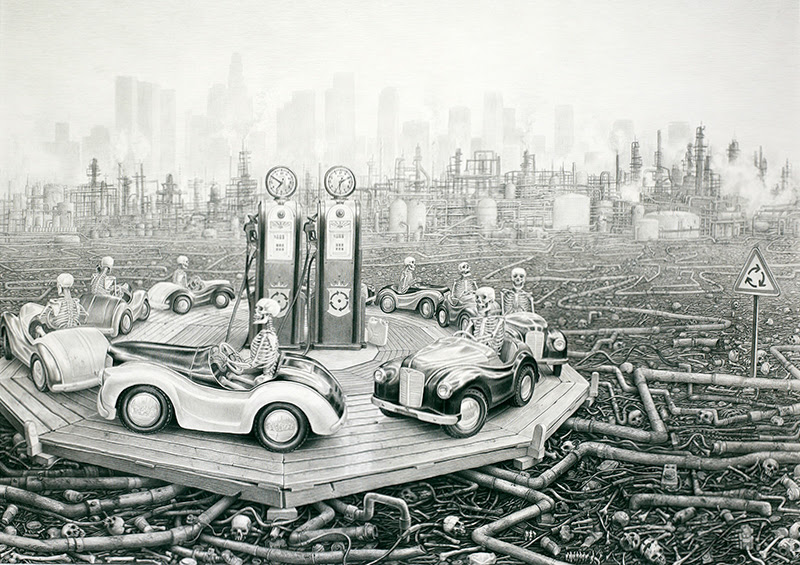
Graphite & Charcoal Drawings by Laurie Lipton.

Graphite & Charcoal Drawings by Laurie Lipton.
"ROUND & ROUND 2012", 37"x53", charcoal & pencil on paper.
An Interview with Laurie Lipton.

Who and where are you from?

I am Laurie Lipton and I was born in NYC, but spent more than half my adult life in Europe. I currently live in Los Angeles.

How you got into this?

I didn't. This got into me. I drew before I could talk. I've been drawing longer than anyone on earth. I don't necessarily think that's a good thing... it's slightly mad.


What is your driving force?

Bliss. Drawing is my bliss.

What kind of work you do and why? 

I draw with graphite & charcoal. Sometimes my drawings are 9foot x 12foot, but the technique is very detailed & tedious. I build up forms using thousands of tiny cross-hatched lines, like an early Renaissance egg-tempera painting but much more complex & difficult. You can't really tell HOW detailed my work is on a computer screen, but people are stunned into silence at my shows. Unlike most "Modern Art", there's so much to  take in.


Tell us more about your thought process.

If I could tell you, in words, about my thought process, I'd be a writer.

Please share with us the one modern artist whose work you find Interesting and why?

Zdzisław Beksiński... because his imagery is unique, powerful, disturbing and brilliantly executed. He died in 2005, but you can find his work easily online. 

Pop Surrealist Paintings by Valentina Toma.

Pop Surrealist Paintings by Valentina Toma.
Felix and the spider - watercolor on wood 35 x 50 cm.
An Interview with Valentina Toma.


Who and where are you from?

I'm Valentina Toma' I was born in north part of Italy but i been lived in many european country , last 10 years between Finland , Malta and Spain where I live right now.

How you got into this?

My father is a painter too so my first toyss is been brush and colors, then i never stop to paint . I also study art, i'm graduate at Accademy of fine art of Firenze.

What is your driving force?

My driving force is fantasy , even do I can be good classic painter my goal time after time is be unconventional even is figuratively, Paint is my black hole where time no matter day pass in a hour and i can fell good.

What kind of work you do and why?

My work can be positioneted in a pop surrealist scene , classic pictorial process coupled with unusual pairs and unlikely events, why I said I like to think that people may be surprised and a the same time be able to see something aggravating.


Tell us more about your thought process.

Some time my process can be long and come from my fantasy some time i dream about , can happen all of a sudden in day the immagine come on my mind is like a can see already and then i follow to build the image already clear for me , no easy dreams come true i try to do in my work.


Please share with us the one modern artist whose work you find Interesting and why?

There is more than one artist I like the work , but my favorite is Greg "Craola" Simkins cos he is amazing with acrylic color in a way I can't be and is full of fantasy and color and invention. 

Paintings by Magdalena Lamri from Paris.

Paintings by Magdalena Lamri from Paris.
The Chair IV 2017 huile sur toile 50x61.
An Interview with Magdalena Lamri.


Who and where are you from?

I am a french artist based in Paris.


How you got into this?

Since childhood, I paint and draw. It is quite naturally that, later, I studied art at the the National School of Applied Arts Olivier de Serres in Paris where i learnt traditional techniques of fresco. I thought of becoming an art restorer.... But the desire to create was too strong !  


What is your driving force?

I would not really know how to define it. I guess my feelings and sensations drive me ... What i know is that to create is vital for me.

What kind of work you do and why?

I work oil painting and also techniques of drawing like charcoal, graphite... The paradoxes are everywhere in my figurative work : I question in particular the borders between dream and reality. The fragility of Nature/Life and the precariousness of the human being are the major themes of my production.  I would like to bring poetry and touch people by essential questions on our contemporary world.

Surrealist Paintings by Steven Kenny.

Surrealist Paintings by Steven Kenny.
The Ribbons, 2015, oil on canvas, 40 x 28 inches.
An Interview with Steven Kenny.

Who and where are you from? 

My name is Steven Kenny. I grew up in a town called Peekskill which is in the beautiful Hudson Valley of New York, about 50 miles north of New York City.


How you got into this? 

In third grade I won first place in a Safety Poster Contest in my age group. That early artistic recognition and praise is very likely the event that set me on the path to becoming an artist.


What is your driving force? 

I think one of the main motivations for most artists is to be heard, seen, understood, appreciated, and loved. Since childhood, art has been the most effective way of attracting attention and expressing my thoughts and feelings. By creating objects of beauty that intrigue viewers I can arouse their curiosity, draw them in, and express myself on multiple, non-verbal levels.


What kind of work you do and why? 

I’m a surrealist. Surrealism allows me to express myself from an intuitive, unconscious place while still painting images that walk a line between reality and dream.

Figurative Art by Konstantinos Skopelitis.

Figurative Art by Konstantinos Skopelitis.
An Interview with Konstantinos Skopelitis.

Who and where are you from?

My name is Konstantinos Skopelitis, and  I'm an artist from Greece. I consider myself as an urban contemporary mostly figurative (but not only) artist ....
Born in a small fish village, my dad used to take me with him when going fishing. I was feeling nautious, my older brother was making fun of me, my dad laughing. I guess I wasn’t a natural talent ready to conquer the seas. I love travelling. Drawing and painting while listening to my favourite indie music

How you got into this?

I remember myself holding a pencil and drawing since I was a child. Drawing whatever triggered my wild imagination. Years went by and my pencil became a brush, a charcoal, a pen. The paper turned to a canvas and painting became a self-discovery journey. I relied on colours to express my feelings, my thoughts, my experiences. My pencil was my closest ally, always there to speak for me when the words couldn't. Faces, scenes from photos, a song I love, a place I visited, an old dusty book, vintage items, through my pop-art interpretation. 


What is your driving force?

My inspiration is hidden and found everywhere in life. My technique can cover mixed media from acrylic, ink, oil, collage among others. Every inspiration is a new journey. Every journey is a new challenge; a challenge I am always willing to take up." When I  hear a story I’m trying to create an image, a face, a woman face at most of the times that suits with the story. Mixing reality and fantasy, with a comic aesthetic often, I create on my mind a figure and that’s it. Make your own story. That’s my moto. That’s how I see it. 

What kind of work you do and why?

It’s mainly ink. Indian and sumi ink. Black and white. My favorite. Drawing with charcoal, acrylic paints, oil, mixing, exploring. Working on newspaper pages… Drawing on the ephemeral. Extending the expire date. Working on old book pages .Make the page my own canvas. A new story covers the old one, fulfilling or maybe changing the meaning. It depends on the viewer and his need to understand why. News and stories. Woman jumping out of book pages bringing their own stories abroad. 

Why women?

Their faces mirroring their emotions almost effortlessly. I capture the moment I want to keep. Do I portray my own likes and beliefs on them? Maybe. A friend noticed that many have blue eyes. She asked me what does it mean. Is it my wife’s blue eyes? The contrast it creates with black? I have to think about it. I’m still discovering myself. When I see a photo or something that intrigues me, an image starts flashing in my head. It has a crush effect, it swallows me defines my moves as the face starts to take shape.

Please tell us more about your thought process.

I love escaping through my art. Life is a crossroad. Life and survival in the Greece of recession crossing over dreams and future steps. Do I call myself an artist? Let me answer this first. What is art? Art is an imaginary shelter for me where I can create from nothing. Every time a new artwork jumps out, it’s another step to my vision. A progress is made and the satisfaction that it’s better than the previous make me feel happy. I don’t know what I will be able to create in the future but maybe this is the most fascinating part of my art vision. There are no borders at all…

In my new series I’m exploring different techniques, bringing more colour, using rough, abstract brushes to create my layers of beauty.

Paintings by Michael Simms from Australia.

Paintings by Michael Simms from Australia.
LoveStick_91x102cm_OilOnCanvas.
An Interview with Michael Simms.

Who and where are you from?

I’m an Australian artist called Michael Simms. I was born in Adelaide in 1987 and moved to Sydney in 2011 where I am now based.

How you got into this?

I spent a lot of time drawing in the home growing up and loved art at school, but I never considered pursuing it as more than a hobby. I eventually studied psychology at university and drew in my spare time. A few years after graduating, I attended evening classes at an art school and went on to win a scholarship to study there full-time. This was the tipping point when art began to take over my life. It was like an addiction. I couldn’t get enough and have continued to dedicate my life to it since then.

When I finished at art school, I created work at home and began entering prizes. This lead to several opportunities to exhibit and commissions – and now I share a studio and gallery space alongside five other artists in North Sydney.

What is your driving force?

The desire to create art is something instinctive that I find difficult to articulate. I’m sure most artists will attest to ‘ebbs and flows’ inherent in the creative process, but the basic joy I find in the art making is the core motivator. 

More specifically, the subject matter is an important driving force. I have to feel a strong connection to what I’m capturing – whether it’s the subject of a portrait, the landscape or symbolic imagery. There has to be genuine passion in order for me to feel creative energy and get into a productive flow.

I also draw inspiration from the work of other artists – painters obviously, but also filmmakers, musicians, writers and actors.  

What kind of work you do and why?

I move between portraiture, landscapes and allegorical works, and am inspired by subjects on the cusp of change.

I find people and the human face infinitely fascinating, and love to experiment with colour, lighting, and subtle expressions to convey their unique temperaments. My work also investigates the evolving notion of portraiture in our culture that is increasingly proliferated with smartphone cameras. I comment on the gap between the authentic self and the ‘virtual self’, and use masks and distortions as a metaphor to explore this.

When it comes to landscapes, my goal is to create dream-like atmospheres that capture the brief moment before an environment is plunged into darkness. I’m drawn to imagery that’s dangerous and beautiful at the same time and reflects the extremes in light and darkness that exists in the world.

Figurative Paintings by Anderson Santos.

Figurative Paintings by Anderson Santos.
Rosso, óleo sobre tela, 46x38cm, 2017.
An Interview with Anderson Santos.

Who and where are you from?

Hello, I'm Anderson Santos a figurative painter born in Salvador, Bahia in Brazil in 1973. I studied Fine Arts at the Federal University of Bahia and today I live and work between Salvador and Milano, Italy, where I am artistic director of the art and technology startup called Ripensarte.

How you got into this?

Because of the work of my father who is a designer, I always had access to drawing materials at home and from a very early start I began to draw. The painting came later, when I was a teenager, it appeared as a need to put color in the drawings that I made. I started first with acrylic paint and already in the School of Fine Arts I met, through colleagues, the technique of oil on canvas and since then I dedicate myself to learn more about it. In 2015 I bought an Ipad and I discovered professional applications to draw and paint directly on the glass screen and I have produced many drawings and digital paintings. I my opinion the digital satisty my old desire to make multiples of my work, like engravings.

What is your driving force?

It seems to me that, today, what moves me is a vital need to paint, to transform what I see and feel in drawing or painting. If I do not paint or draw I do not feel complete, it has become something necessary like blinking, breathing or sleeping. I need to paint.

What kind of work you do and why?

I am a painter who is interested in the human figure, my painting is realistic and I basically make portraits of people and animals. I study very much the work of other painters and I make many references in my painting to the work of Velasquez and Francis Bacon that are for me the starting point. I'm interested in seeing how the time affects the skin, how it leaves marks and now how it rearranges the bodies.

Please tell us more about your thought process.

I always start from an idea and then I turn it into a photographic reference. If I already have a photograph that serves me to paint this idea, it's okay, If not, I make photographs with a model. Then I start painting, by digital or oil on canvas. At that point, what I'm interested in is how much I can put on or get out of there, without getting too far away from the starting point. When I'm painting a woman, I would like you to recognize that it's a woman, not a dog, but, at the same time, I wish that the marks on it should suggest you that you are looking to a paint arranging on canvas. Reminding that what's before your eyes is a painting, a work by a brain and human hands.

Paintings by Arturo Samaniego.

Paintings by Arturo Samaniego.
An Interview with Arturo Samaniego.

Where are you from and how you got into this?

I was born in Mexico, where I did my initial studies in drawing and painting. I went to University of Texas where I obtained degrees in Fine Art as well as Computer Science. For 15 years after that my life was split between the business world in computers, and the Art world. In 2004 I decided to leave the corporate environment to pursue my true calling and devote myself to the creation of Art. It was a difficult transition but one I will never regret.

What is your driving force?

I believe great Art requires Creativity and inspiration, but also a high level of Craftsmanship. For this reason, throughout my career, I have strived for a refined technique that becomes the instrument of  a personal artistic language.


What kind of work you do and why?

The Sea  has been a recurring theme in my paintings of the last few years, for many reasons: Its great beauty and mistery, its metaphorical representation of life itself, enveloping and nurturing on the surface, but also unpredictable and treacherous like the currents and surf that inhabit it.

My newest series of Oval paintings explores the always exciting relationship between representational and Abstract, with both styles interacting in a visual dialogue.

My work is currently displayed in galleries accross the United States, including Mary Martin Gallery of Naples, Fl and in Charleston, SC. I have had solo and group shows in New York, Miami, and Austin, among many others.

My paintings are in private collections around the world, and have been featured in many prestigious publications such as International Artist Magazine, Juxtapoze, Manifest Galllery International Painting Annual, Studio Visit Magazine, The ArtList Editors, etc.

Portraiture Paintings by Sal Jones from London.

Portraiture Paintings by Sal Jones from London.
Here I Am, Inside, oil on canvas, 100 x 70 cm
An Interview with Sal Jones.

Who and where are you from?

My name is Sal Jones, I’m a contemporary figurative artist working predominantly with oil on canvas.Originally I’m from the East Midlands area but I have been in London for a long time now, I live and have a studio space in Hackney, London.

How you got into this?

I always created things from a young age (whether sticking things down, painting or cutting things up). I studied Fine Art at college and later did a PGCE in Art & Design Education. I have worked across various art forms and media in the past (including painting, assemblage sculpture, analogue and digital photography). As well as my art practices I have taught Art & Design, undertaken residencies in schools and work freelance in the Art & Design education sector. 


What is your driving force?

I get a sense of satisfaction out of creating art and I enjoy seeing an image appear. The possibilities when a painting is only partially complete are really exciting - that’s where the energy comes from.

I like to think making art it is a form of communication with others, as the artist, I select the images and paint them in a way that perhaps says more about how I am feeling and the context in which they are created than I realise. 

What kind of work you do and why?

The paintings I have been doing recently are best described as a reinterpretation of the portraiture tradition with an emphasis on emotional conflict and expression. But unlike traditional portraiture, there are no sitters and they do not represent a specific person but rather suggest an emotive state. They are not specifically posed but capture a moment in time. I hope to draw the viewer into an unknown scenario, one in which they are invited to speculate what the subject is thinking about.The paintings have been inspired by images of facial expressions appropriated from film, and the media, which have been taken out of context and re-presented as paintings, with an emphasis on colour, and mark making.

I have been using dialogue as titles to open up a line of communication between subject and spectator. I hope to interact with the viewer by creating works that they can relate to or empathise with on a personal level.


Please tell us more about your thought process.

I like to think of my paintings as a commentary on what it is like and how it feels to live or even just to exist in our times. 

I don’t draw out the image in advance but work with thin washes of paint to plan out the image directly onto the canvas, once the composition is established I then work on layers of paint using brushes and palette knife.Experimenting with paint application is part of the process.

I usually start with a photograph or series of photos that I use as a resource to plan the composition and to get enough of the representation that I require – but that’s where it ends – I then use colour and mark-making to emphasise the expression and emotion of the subject, I’m not interested in a photo-realist finish. I suppose I sort of re-animate a photographic source through the painting process.

Realistic Figurative Paintings by Enrique Collar.

Realistic Figurative Paintings by Enrique Collar.
Bollywood #14, oil on linen 120×80 cm 2014
An Interview with Enrique Collar.

Who and where are you from?

I was born in the countryside of Paraguay, I grew up in Buenos Aires and I live and work in Rotterdam since 2003. I am a visual artist and a film director.

How you got into this? 

Painting caught me from the first moment I discovered it. As a child I studied comic strips which came by mail. As a teenager I worked in printing companies. The reproduction, the ink, the papers and the needed recovery of my first years of life in the field of Paraguay, pushed me towards the art. 

I came in the world of cinema because of painting. During the last decade of the twentieth century, I drew and painted intensely Paraguay, My work was created within the Latin American cultural context, with myths and realities. This work became very important for the Visual Arts of my country, and that I developed this without being aware of this.

When I came to Holland, I decided to close this period and start another. I was always a figurative artist, although I allowed myself to explore various currents of art history, which I interpret in a “nonlinear way". In this new stage, (which you can see in the photographs) I introduced my painting to the visual qualities that were appearing in this digital life. I chose to concentrate on the pictorial act of the details; the light and the forms. As I changed cameras, my paintings varied. In other words; I did the opposite of my Latin American period, where I prioritized the language of space, composition and narrative. But slowly, from large portraits I’m going back to the concepts of space, but now from a different perspective. I believe in the process of visual thinking and how this modifies our vision.

What is your driving force?

The history of art, the art of painting and for past few years the fascination for the new visual tools that Technology can give us. Putting technology together with the tradition of 500 years painting makes me enthousiastic. One of my latest projects is: Universal Painting Project 360° VR, paintings in 360 degrees, which can already be seen on my website, but the originals will be part of an upcoming exhibition in Rotterdam.

What kind of work you do and why?

I have always been fascinated by the representation of reality in a flat world through pictorial language. In three decades of artwork, my perception changed over multiple periods. I also added the language of cinema, narrative in time and script writing in what paintings mean to me. Teamwork with technicians from different disciplines and actors was an important human experience. Thanks to the cinema I could incorporate the concept of 360 degrees in my paintings, and this makes me excited.

Please tell us more about your thought process.

When I started, I drew from a direct model and then painted these drawings. Then I experimented with analog photography, and collages. Later photoshop, screens, tablets, and video Stills. I do not have a unique methodology of work. It depends a lot on the project type and sometimes the mood.

The art of painting is for me the most essential language where I concentrate my emotions, my ideas and the real time that I live with every work. This process can take me up to several weeks. It is difficult to maintain a work routine or draw accurately on the canvas what I’m going to paint. I need the stain, the gesture, the error, different techniques. I need the layers of paint that, although they may disappear at first sight, they remain there under what we see, as a heart secretly beating. To sum up my sensitivity towards pictorial language; I am interested both in the art of Willem de Kooning as well as in the art of Lucien Freud, and I have always been deeply excited by Vermeer of Delft.

Figurative Paintings by Karen Bradley.

Figurative Paintings by Karen Bradley.
Daydreamer.
From the Brush of Karen Bradley.

I am a contemporary realist painter based in Savannah, GA. I have always loved drawing the figure. My background is in Medical illustration, which offered some figurative illustration here and there, but ultimately I wanted more than purely meeting someone else’s objective. I truly loved portraiture and began to study it more seriously than ever about 6 years ago. The more workshops and conventions I attended, the more hope I had that I could make a living out of doing what I love. I would say my driving force is self expression. Most of my models are women because, well, they are beautiful and also I relate best to them. Sometimes I want to paint a face because I can’t stop looking at it and other times it’s a feeling or condition that I want to express. 

I do have a 10-month old which has cut way into my painting time. This has changed the way I paint because of all the interruptions and also changed the way I feel about painting. Painting from life is very fulfilling for me… the process and the outcome. Fulfilling my needs seems more important than ever now. So I have scheduled friends to come sit for me every Saturday while my husband can keep the baby. I also am doing a paintings per day for 60 days.These practices are to keep me going even when it feels like too much work. Posting to social media helps keep me accountable and connected to my artist friends. It also can be an advertising tool, I suppose. 

I have a solo show coming up in April which will be figurative in subject matter with focus on the human condition and intimacy, and a lack there of. This topic interests me so much and I look forward to diving into it. 

I’ve placed my bio below for a little more on what and why I paint.

Karen Bradley is a contemporary figurative realist oil painter based in Savannah, GA. Her paintings focus on portraiture and figurative subject matter. Her inspiration comes primarily from people she encounters, their expressive qualities and patterns of light and shadow that reveal them. Karen’s works are honest visual interpretations of her experiences as she perceives them.

Karen has participated in several solo and group exhibitions, and her figurative paintings have won numerous awards including first place and Best of Show. Her work is featured in numerous private and public collections.

Karen’s artistic career began in Medical Illustration. She served as a Foundations Faculty member for several years at the Savannah College of Art and Design. Her passion for the human figure drove her to pursue greater education in figurative painting. Karen studied at the Art Student’s League of New York as well as Studio Incamminati of Philadelphia and has worked with many established artists such as Joseph Todorovitch, Max Ginsberg, and Robert Liberace. She is an active member of the Oil Painters of America and The Portrait Society of America. 

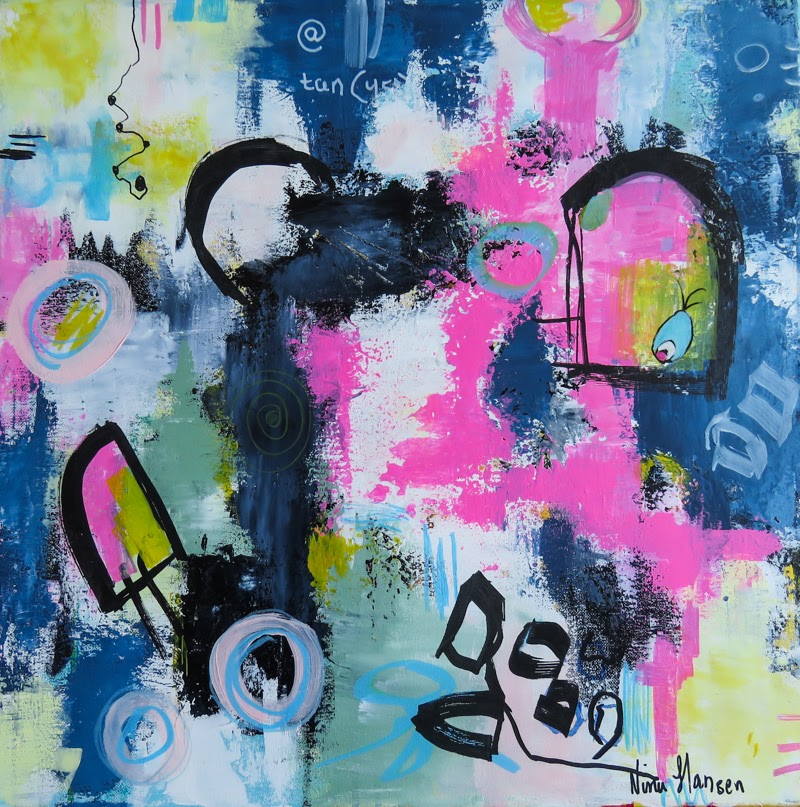
Paintings by Nina Hansen from Denmark.

Paintings by Nina Hansen from Denmark.
Go for it 50x50 cm.
An Interview with Nina Hansen.

Who and from where are you?

My name is Nina Hansen. I was born in Bergen, Norway. Now living in Denmark.

How you got into this?

I have always been fascinated by art and design. I have been drawing since I was a child. At that time I drew mostly animals, like dogs and horses. Later I have started to paint with acrylic on canvas.

What is your driving force?

Being creative has always been a driving force in my life. Painting is my soul, and gives me great joy and relaxation. It lends me the opportunity to express myself and release an otherwise uncontrollable energy, which bring my back to the studio almost every day. I love to find new ways to express myself, and the idea to focus on details in a new way is very rewarding

What kind of work you do and why?

I paint mostly whit acrylic and paint marker. My paintings are abstract and contemporary with strong vibrant colors. I am experimenting with shape, colors and different techniques. My tools are usually painting knife, spatula and fingers. It is impossible for me to predict the final outcome. It is evolving gradually in the making.

The vivid colors are meant to induce happiness and vitality to the viewer.

I am working with intuition and expressionism. The process is investigative, and the randomness of
sudden evolving shapes and strokes, are creating a multitude of paths. 

My final goal is to take the viewer on a trip in to their own imagination……. and out of the ordinary.

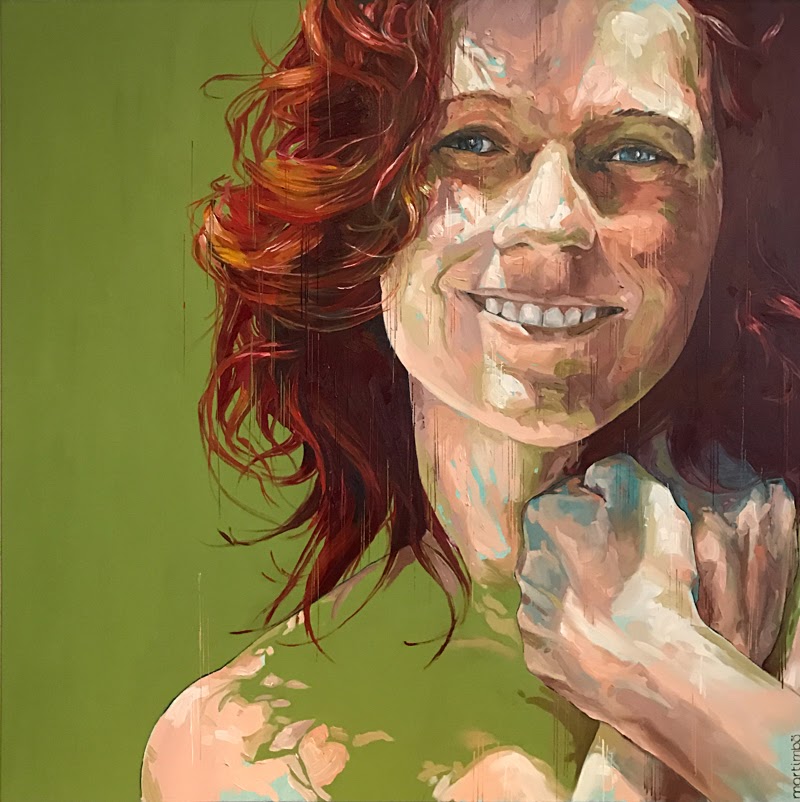
Portraiture Paintings by Joel Martimbeault.

Portraiture Paintings by Joel Martimbeault.
The Gift.
An Interview with Joel Martimbeault.

Who and where are you from?

My name is Joel Martimbeault and i was born in Manitoba Canada, but have lived most of my life in and around Montreal, Quebec. 

How you got into this?

I only took up painting more seriously in my forties, visual arts seeming like the next step for someone who had always delved in creative and visual disciplines: graphic arts, woodworking and interior design. For the most part i am a self-taught artist, initially experimenting with color and texture with abstract landscapes. Moving into portraiture, i continued working with similar textures and bold colors. As I began this foray into portraits i also completed a certification as a life coach. This had a huge influence on how i approached painting from that point on. Bringing these 2 passions together influenced me to make the emotion the true subject of my work. 

What is my driving force?

Connection. 
The connection and intimacy with the subject that builds up through the process of painting. An opportunity to connect with the emotion, to experience it through art in a way i don't always allow myself to in everyday life. Connecting and moving people with my work. My greatest accomplishment is knowing that i can move people with my art.

What kind of work you do and why? 

My process begins by first choosing the emotion i feel i need to explore; something personal i can relate to and connect with. I choose my subjects with the knowledge that they can channel those feelings, that experience. We find common ground and i get to experience it through them. It's a very intimate and rewarding process for me. 

The eyes are where I first focus when I begin my work. There is where I can capture and immortalize the feeling that my subject portrays. With my expressive use of colour I hope to evoke the spiritual and emotional statement of my subject. I like to juxtapose the linear rhythms of my brushstrokes against the tactile and textural swathes of the palette knife. The quick application of paint allows me to express the immediacy of the moment; for I believe that emotions can change in a split second. The highs and lows of shadows create a contrast that may enhance or contradict the sentiment.  My background as a life coach has allowed me to have a close relationship with feelings and emotions and I welcome the viewer to create their own interpretation of what the person may be experiencing.

In a time of selfies and social narcissism  I want the emotion to take front stage, to allow ourselves to view the subject from within.